
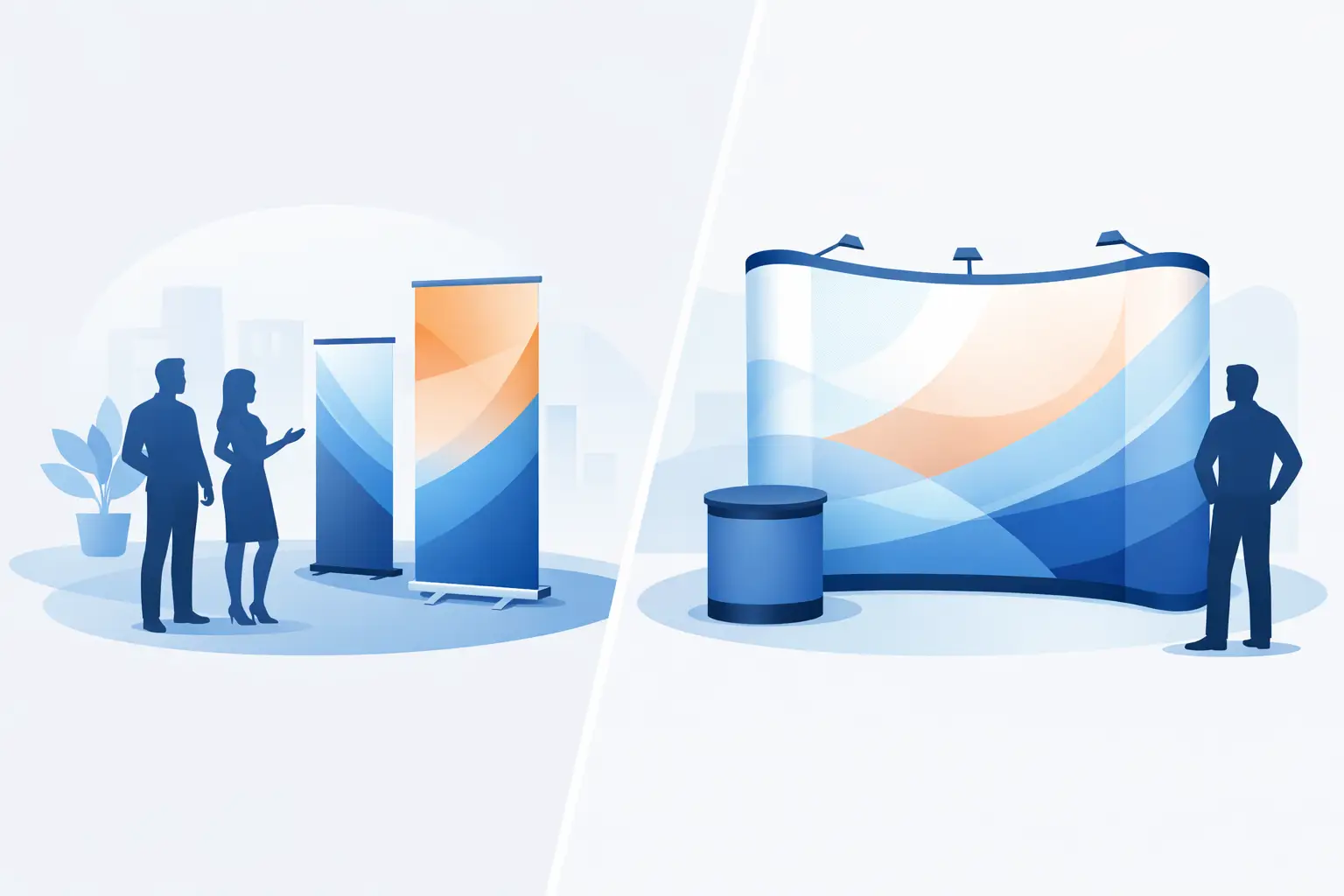

A 10×10 booth can look organized or forgettable based on one decision: how you present your brand at eye level. When businesses compare banner stands vs pop up displays, they are usually balancing three things at once – budget, visual impact, and setup speed. The right choice depends less on which product is “better” and more on where it will be used, how often it will travel, and what kind of impression the brand needs to make.
Banner stands vs pop up displays: what is the real difference?
Banner stands are vertical display units that hold a printed graphic in a narrow footprint. They are commonly used for promotions, directional messaging, product features, sponsor branding, reception areas, and simple event backdrops. Most buyers choose them because they are compact, easy to transport, and cost-effective for recurring use.
Pop up displays are larger presentation systems designed to create more visual coverage. They are often used as trade show back walls, media walls, branded photo areas, and full booth displays. Their main advantage is presence. They fill more space, carry more messaging, and create a stronger branded environment than a single stand-alone banner.
That size difference shapes almost every buying decision. A banner stand is usually a tactical display item. A pop up display is more often part of a broader event setup.
When banner stands make more business sense
If your team attends multiple events each quarter, portability matters. Banner stands are easier to carry between venues, easier to store in the office, and quicker to replace when campaign messaging changes. For procurement teams managing several branches, departments, or activation sites, that flexibility can be more valuable than scale.
They also work well when the display has one clear job. That might be announcing a product launch, welcoming visitors to a conference room, reinforcing a sponsor message, or supporting a sales table at a networking event. In those cases, you do not always need a full branded wall. You need a clean, visible message that can be installed in minutes.
Cost is another practical factor. If a company needs multiple units across regions or for separate internal teams, banner stands usually allow wider deployment without stretching the event budget. Instead of investing in one large structure, buyers can often equip several locations with consistent branded graphics.
There is a trade-off, though. One banner stand can look too light for a premium exhibition setting, especially if competitors are using larger booth systems. It can also limit how much information you present. If your message depends on product visuals, feature comparisons, brand storytelling, and a strong backdrop for meetings, a narrow vertical graphic may not be enough.
Best use cases for banner stands
Banner stands are a strong fit for reception spaces, hotel conferences, campus events, retail promotions, internal corporate functions, and satellite activations. They are also useful when a brand wants to support a larger display with extra messaging on the sides of a booth.
In practical terms, they suit teams that need speed, repeat use, and easy transport more than dramatic presentation.
When pop up displays are the stronger option
Pop up displays make sense when visibility is the priority. At trade shows and exhibitions, distance matters. A larger backdrop helps attendees identify your booth from farther away, and it gives your brand more authority in a busy hall.
This becomes even more important when several people are working the stand at once. A pop up display creates a proper branded zone behind staff, product tables, and engagement areas. That visual structure can make the booth feel planned rather than temporary.
They also give marketing teams more room to work with. Instead of forcing one headline and one image into a narrow format, a pop up display can carry layered branding. You can include key value propositions, category visuals, campaign themes, and stronger graphic continuity. For businesses with multiple service lines or product families, that extra space can improve message clarity.
The trade-off is logistics. Pop up displays require more storage space, more careful transport, and sometimes more setup coordination depending on the size and frame type. They are still built for events, but they are not as grab-and-go as a standard banner stand. If your event team is small or your schedule involves frequent venue changes, this matters.
Best use cases for pop up displays
Pop up displays are usually the better choice for exhibitions, trade fair booths, brand launch events, media walls, recruiting fairs, and corporate showcases where presentation standards are high. They are especially useful when your display needs to anchor the full booth rather than support it.
If the display will appear in photos, videos, press coverage, or social content from the event, the larger branded surface can also add long-term marketing value beyond the event day itself.
Comparing banner stands vs pop up displays by buying criteria
For most business buyers, the decision comes down to a few operational questions.
If budget is tight and you need several branded units, banner stands usually offer better coverage per dollar. They are practical for repeat use and simple campaigns. If the priority is making one space look more complete and more premium, pop up displays often justify the higher spend.
If setup time is critical, banner stands generally win. Teams can unpack and position them quickly with minimal instruction. Pop up displays are still manageable, but they can involve more parts, alignment, and handling.
If your brand needs maximum visibility, pop up displays have the edge. They provide stronger stage presence and create a cleaner visual background for meetings, conversations, and photography. Banner stands are visible, but they rarely dominate a space.
If transport is the main issue, banner stands are easier to move through hotels, offices, event halls, and frequent activations. For traveling sales teams or multi-location campaigns, that convenience should not be underestimated.
If your messaging changes often, banner stands can also be easier to update across multiple campaigns. That is useful for seasonal promotions, rotating offers, event-specific messaging, or internal communications.
The design question buyers often overlook
The display format matters, but the artwork matters just as much. A poorly designed pop up display will still look weak, and a well-designed banner stand can outperform expectations in the right setting.
For banner stands, clarity is everything. The message should be readable from a distance, with a strong headline, limited copy, and a visual hierarchy that gets the point across fast. Overloading a narrow layout usually reduces impact.
For pop up displays, consistency matters more. Because the format is larger, spacing, image quality, logo placement, and message flow all need more planning. A large display gives more room, but it also makes design flaws more visible.
This is where working with one supplier for printed materials and event branding can make the process easier. When the same team handles display graphics alongside supporting assets such as brochures, counters, backdrops, and branded giveaway items, brand consistency is easier to maintain and execution is usually faster.
Should you choose one or use both?
For many companies, the best answer is not either-or. It is a combination.
A pop up display can serve as the main branded backdrop, while banner stands carry secondary messaging around the booth perimeter, entrance, or meeting area. This layered approach works well for exhibitors who want a professional central presence without losing flexibility.
It also helps when the same event assets need to serve different functions. The large display handles booth branding, while banner stands can be reused later in offices, roadshows, partner events, or product demos. That extends the value of your printed materials beyond a single event.
For businesses managing recurring exhibitions or procurement cycles, this mixed setup can be the most efficient long-term investment.
How to make the right call for your event
Start with the venue and the role of the display. If you are furnishing a small registration point, side area, hallway activation, or reception space, a banner stand is often enough. If you are building a primary exhibition presence or need a clean branded background for customer interaction, a pop up display is usually the stronger fit.
Then look at frequency of use. One flagship event may justify a larger display. Repeated use across many smaller events may favor banner stands. Also consider who will handle the setup. A marketing team with event support may be comfortable with larger systems. A sales team working independently may prefer simpler portable formats.
Finally, think beyond the event date. Good display choices support future campaigns, internal use, and brand consistency across touchpoints. That is where a practical supplier matters. A business like The Wrapperz can support not just the display itself, but the surrounding branded materials that make the full setup look coordinated.
The best display is the one that fits your event goals without creating extra friction for your team. If you choose with that in mind, the result will look sharper, travel better, and work harder every time you put it on the floor.