
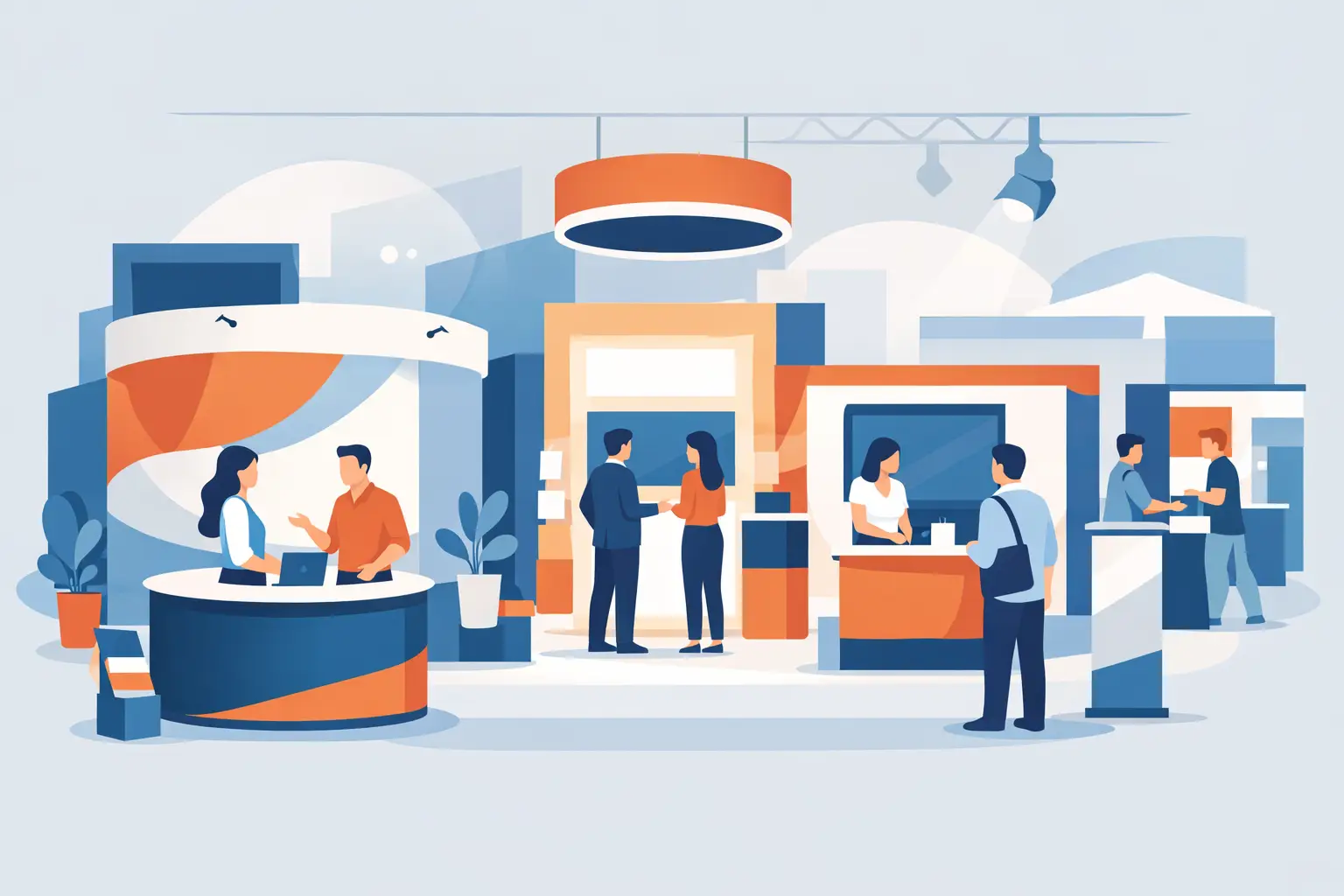

A crowded trade show floor gives you only a few seconds to make sense to the right visitor. That is why strong exhibition booth branding ideas matter – not as decoration, but as a practical way to signal who you are, what you offer, and why someone should stop at your space instead of the next one.
For most exhibitors, the problem is not lack of effort. It is mixed messaging. A premium product displayed on a generic table. Great staff wearing mismatched apparel. Printed collateral that looks unrelated to the booth graphics. The result is familiar: foot traffic passes by, conversations start slowly, and follow-up value drops because the brand was never clear in the first place.
The better approach is to treat the booth as a complete branded environment. Every visible surface, handout, display element, and giveaway should work together. Below are 11 ideas that help companies build a booth presence that looks professional, stays consistent, and supports actual event goals.
Exhibition booth branding ideas that improve visibility
1. Start with one clear message, not five
Many booths try to sell everything at once. That usually weakens recall. A visitor walking by should understand your offer in a glance, whether that is a product category, a service outcome, or a business advantage.
Your main wall graphic should carry one headline that is easy to read from a distance. Supporting lines can explain details, but the primary statement needs to do the heavy lifting. If your company serves multiple sectors, choose the message most relevant to that event audience instead of presenting a broad company profile.
This is one of the simplest exhibition booth branding ideas, but it has a major effect on performance. Clarity gets attention faster than complexity.
2. Build the booth around your brand colors and visual system
Brand colors are not enough on their own. The booth should also reflect your typography, graphic style, icon use, imagery, and spacing. When those elements match your website, brochures, presentation decks, and printed materials, the brand feels established rather than improvised.
There is a trade-off here. Too much color can make a booth look busy, while too little can make it disappear into the venue. In most cases, it works best to use one dominant brand color, one secondary color, and clean neutral space so the key message stays readable.
Consistency is what turns a booth from a display into brand recognition.
3. Use height to win attention from a distance
On a busy exhibition floor, eye-level branding competes with everything nearby. Suspended signs, tall backdrops, branded towers, and elevated header panels help your booth get noticed well before visitors reach your aisle.
This matters even more for businesses positioned away from the main entrance or central walkway. If your booth location is not ideal, vertical branding can recover some of that lost visibility. The design should stay clean and bold. High placement is valuable only if people can read it quickly.
4. Brand the counters, not just the back wall
A common mistake is treating the counter as functional furniture instead of branded space. In reality, reception counters and demo tables sit closest to visitors and appear in many event photos. They should carry logos, color blocks, campaign graphics, or a concise message.
Counter wraps are especially useful for smaller booth footprints, where every visible surface needs to work harder. They also help unify the space when visitors approach from an angle and do not immediately face the main backdrop.
Exhibition booth branding ideas for a more complete setup
5. Coordinate staff appearance with the booth
Booth branding is not limited to print. Staff are part of the visual system. Branded shirts, jackets, lanyards, badges, and even simple color coordination make the team easier to identify and help the booth look organized.
This is particularly important when your team is handling a high volume of conversations. Visitors should not have to guess who works there. For procurement-heavy events and B2B exhibitions, a polished staff presentation also reinforces trust. It signals that the business is structured, prepared, and serious about delivery.
The practical point is simple: if the booth says one thing and the team looks disconnected from it, the overall impression weakens.
6. Match printed collateral to the booth graphics
Your brochures, flyers, catalogs, folders, business cards, and product sheets should feel like extensions of the booth. If a visitor takes materials away, those pieces need to carry the same headline, visual style, and offer they saw at the stand.
This is where many companies lose momentum. The booth may be current, but the handouts are old, generic, or designed in a different style. When that happens, the event experience becomes fragmented.
A consistent print set improves recall after the show and makes internal sharing easier when your contact passes the materials to a colleague.
7. Use branded giveaways with actual event relevance
Promotional products can support booth branding if they are chosen well. They should align with the audience, the event setting, and your brand position. Useful items such as drinkware, tote bags, notebooks, tech accessories, or writing instruments often perform better than novelty products because they stay in circulation longer.
The branding itself should be clean and professional. Oversized logos can make an item look disposable. Good giveaway branding balances visibility with usability.
It also helps to connect the product to the booth experience. If you are launching a sustainability message, eco-friendly items make sense. If your audience is made up of executives or procurement teams, better-finished products may deliver stronger brand value than low-cost volume pieces.
8. Add one interactive branded element
Not every booth needs a screen-heavy experience, but most benefit from one interactive feature. That could be a product demo station, a digital presentation screen, a sample wall, a spin-to-win activation, or a simple consultation table with clear signage.
The key is to keep the interaction tied to your commercial objective. If it gathers leads, qualify them. If it demonstrates a product, make the benefit obvious. If it exists only to attract a crowd without supporting follow-up, it may not justify the floor space or staffing time.
Well-branded interaction gives visitors a reason to stop and gives your team a natural way to start the conversation.
9. Design for photos and social sharing
Exhibition visitors and event organizers take photos constantly. That means your booth should look good on camera, not just in person. Clean backgrounds, visible logos, balanced lighting, and uncluttered counters all improve how your booth appears in photos.
A branded photo moment can help here, especially if the event encourages social coverage. This does not need to be overdesigned. A well-placed backdrop, campaign line, or product display wall can be enough.
Think about what appears behind your staff during meetings, product demos, and handshake photos. Those images often travel further than the event itself.
10. Plan the visitor journey inside the booth
Strong branding is not only visual. It also shapes how people move through the space. Visitors should know where to enter, where to browse, where to sit, and where to speak to someone. If the layout is confusing, even a good-looking booth can underperform.
For compact spaces, keep the front open and avoid placing tall elements where they block access. For larger booths, create zones for greeting, demonstration, discussion, and literature pickup. Branded signage should support those zones instead of overwhelming them.
This is where exhibition design and brand execution need to work together. A booth that looks impressive but interrupts traffic flow can cost you conversations.
11. Keep every branded item tied to one event objective
The best booths are not branded for branding’s sake. They are built to do something specific – launch a product, book meetings, generate leads, support distributors, or increase recall with existing clients.
When the objective is clear, branding decisions become easier. Premium finishes may matter more for relationship-driven events. Larger headlines and simple graphics may matter more for high-traffic exhibitions. More printed literature may be useful for technical sectors, while demonstration space may be more valuable for product-led categories.
This is also where working with a single supplier can reduce friction. When booth graphics, printed materials, branded apparel, event giveaways, and display accessories are planned together, execution tends to be faster and more consistent. For businesses managing multiple branded assets at once, that convenience matters as much as the design itself. Companies that need one source for exhibition displays, merchandise, and print production often prefer that model because it reduces coordination errors and helps maintain brand control. That is a practical reason many buyers use providers such as The Wrapperz for event branding support.
What makes booth branding actually effective
The most effective exhibition booth branding ideas are usually the least confusing. They do not overload the stand with messages, products, and visual noise. They make the brand recognizable, the offer understandable, and the next step obvious.
If you are planning an upcoming exhibition, start by checking whether your booth, print materials, giveaways, and team presentation all look like they belong to the same company. That one decision often separates a booth that gets noticed from one that gets remembered.