
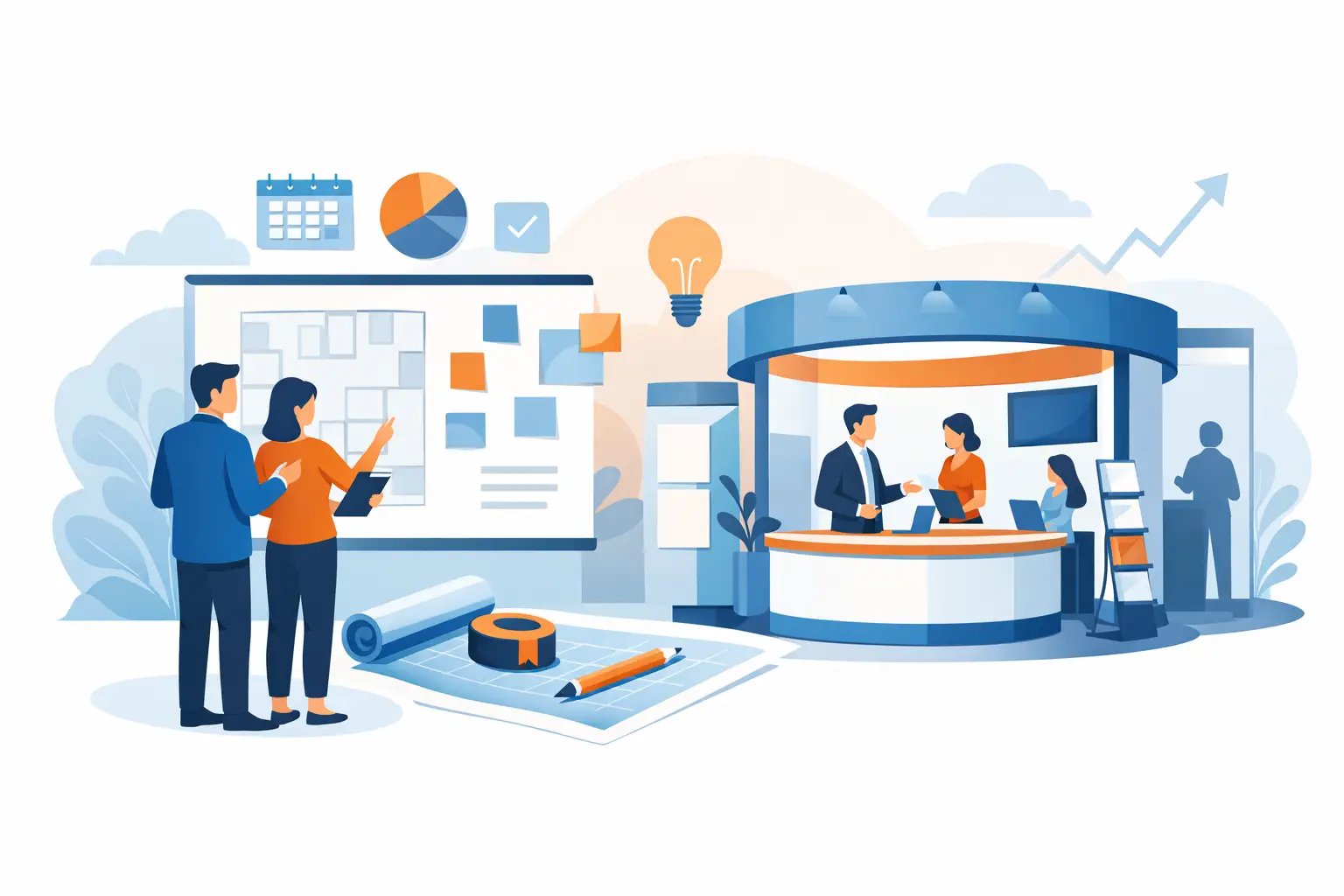

A crowded expo hall can make even a strong brand disappear. The difference usually is not the booth size or the biggest budget. It is whether your team followed a solid trade show booth planning guide that aligns layout, branding, staffing, print materials, and giveaways around one clear objective.
For most businesses, trade show performance is won before the event opens. If your display, handouts, branded merchandise, and team message are being sourced separately, small inconsistencies start to add up. Colors shift. Messaging gets diluted. Delivery timelines tighten. The result is a booth that looks assembled instead of managed. Good planning prevents that.
What a trade show booth planning guide should solve
A practical trade show booth planning guide is not just a checklist of banners and tables. It should help you answer a more commercial question: what is this booth supposed to do for the business?
That answer changes everything. A company launching a product may need demo space, branded backdrops, and quick-take brochures. A business focused on lead generation may need a more open layout, clear callouts, badge scanning workflow, and giveaways tied to follow-up. A university or public institution may need stronger information display, printed materials by audience type, and a booth setup that supports longer conversations.
Once the goal is clear, product selection gets easier. Instead of ordering items because they are commonly used at exhibitions, you choose what supports the outcome. That is how budgets stay controlled and the booth feels intentional.
Start with goals, not graphics
Many teams begin with the booth backdrop artwork. That is usually too late in the process. Before design starts, define success in measurable terms. You might be targeting qualified leads, distributor meetings, product awareness, recruiting conversations, or client retention. Each target affects booth structure and supporting materials.
If your primary goal is lead generation, your space should make it easy for visitors to enter, engage, and leave their details without congestion. If your goal is brand positioning, the visual finish matters more, and premium print quality, consistent messaging, and polished presentation become central. If meetings are the priority, privacy and seating may matter more than high-volume traffic flow.
This is also where internal alignment matters. Marketing may want visibility, sales may want appointments, and procurement may want spend control. A realistic plan balances all three.
Build the booth around visitor behavior
The best booths are easy to read from a distance and easy to use up close. Visitors decide within seconds whether to stop, so your main message must be visible fast. That means fewer claims, larger text, and stronger hierarchy.
Think in three zones. The first is attraction, where branded walls, counters, digital screens, or hanging signage catch attention. The second is engagement, where visitors can ask questions, handle products, view samples, or pick up literature. The third is conversion, where your team captures details, books a follow-up, or directs the visitor to the next action.
This is where sizing trade-offs show up. A larger booth gives you more room, but it also demands more structure, more staffing, and more branded assets to avoid looking empty. A compact booth can perform well if the message is tighter and the product display is selective. Bigger is not automatically better.
Booth design and branding need consistency
One of the most common exhibition problems is mixed branding across the booth, flyers, product packaging, and giveaways. Even when each item looks fine on its own, the overall effect can feel fragmented.
Your booth should use one visual system across all assets. That includes the backdrop, roll-up banners, counters, table covers, brochures, business cards, name badges, product labels, and giveaway packaging. Fonts, colors, image style, and brand language should match. If you are presenting samples, even the way they are arranged contributes to perceived quality.
For companies managing multiple vendors, this is often where delays and mismatches happen. A centralized approach reduces revision cycles and improves consistency because print materials, branded merchandise, and display items are planned together instead of being patched in near the deadline.
Choose the right materials for the event type
Not every event requires the same booth package. A major industry exhibition may justify a custom exhibition booth, premium fabric graphics, demo counters, branded walls, and high-volume handouts. A conference table-top setup may need only a compact display, printed brochures, a branded table throw, and a few practical giveaway items.
Your material mix should reflect audience behavior. If attendees move quickly, oversized printed messaging and grab-and-go merchandise work better than dense brochures. If conversations are longer and more technical, catalogs, folders, printed spec sheets, and organized leave-behinds become more useful.
The same logic applies to promotional products. Useful items tend to last longer in the visitor’s hands, but premium items should be reserved for the right audience segment. Not every lead needs the same level of giveaway investment.
A trade show booth planning guide for print and promo items
Printed collateral and promotional merchandise should support the booth, not distract from it. That sounds obvious, yet many teams order generic giveaway items first and then try to fit the rest of the brand around them.
Start with what visitors should remember after they leave. If the answer is your product range, your brochure, catalog, or printed one-pager needs priority. If the answer is your brand, your merchandise should be practical, well-finished, and clearly branded without looking overdesigned. If the answer is your service capability, samples, case study sheets, and a well-trained booth team may matter more than high giveaway volume.
Popular event items still work when they match the setting. Branded drinkware, tote bags, notebooks, pens, technology accessories, lanyards, and eco-friendly products remain useful because they extend visibility beyond the booth. The difference is customization quality and relevance. A thoughtfully selected item with strong print execution performs better than a high quantity of forgettable stock.
Packaging also matters more than many buyers expect. When merchandise, printed inserts, and brand visuals are coordinated, the business appears more established. That is especially important in B2B settings where buyers are judging reliability as much as creativity.
Plan operations early, not last
A booth can look excellent on paper and still underperform because the operational details were treated as an afterthought. Shipping timelines, installation windows, venue rules, electrical access, storage, internet requirements, and on-site staffing all affect execution.
Your timeline should include design approval, production lead times, print proofing, quantity checks, packing, delivery, and contingency stock. If you are exhibiting in Dubai or managing a regional event schedule with tight setup windows, this becomes even more important because last-minute replacement options may be limited depending on the item category.
Staff readiness is just as important as physical setup. Your team should know the booth objective, the target visitor profile, the key talking points, and what to do after each conversation. A polished booth with an unprepared team will still lose opportunities.
Budget for impact, not just cost
Trade show budgets often get squeezed in the wrong places. Teams cut visible branding elements or printed materials, then overspend on low-value extras ordered late. A better approach is to rank spend by business impact.
The highest-priority budget areas are usually the core booth structure, large-format branding, essential print materials, and selected merchandise that supports the event goal. Decorative add-ons come later. If budget is limited, reduce quantity, simplify the display, or focus on fewer high-performing assets rather than spreading spend across too many categories.
It also helps to separate reusable and event-specific items. Exhibition booths, branded counters, and certain display hardware may be reused across multiple events. Flyers with event-specific messaging usually cannot. That distinction improves purchasing decisions over time.
After the event, measure what actually worked
Booth planning should include post-event evaluation before the show even starts. Otherwise, teams rely on impressions instead of evidence. Decide in advance what you will measure, whether that is lead count, meeting quality, brochure uptake, giveaway response, or post-show conversion.
Ask practical questions. Which printed materials ran out first? Which products attracted attention? Did the booth layout cause bottlenecks? Were premium giveaways given to the right contacts? Did the team capture useful lead data or just volume? These answers make the next event more efficient.
For organizations exhibiting regularly, the strongest results come from treating booth planning as an ongoing system, not a one-time project. The more coordinated your display materials, printed assets, merchandise, and follow-up process become, the easier it is to scale event activity without increasing confusion.
If you want better trade show outcomes, think less about filling a booth and more about building a complete brand environment. When the message, materials, and logistics all point in the same direction, your booth stops being just a presence on the floor and starts working like a business tool.